See your building the way the bank does.
Every green strategy you already know has a line in a spreadsheet. Learn the three numbers that decide whether a building gets built, then take the spreadsheet apart with design.
Where the money goes
Before anyone talks about rent or returns, the building is a pile of costs. Underwriters sort that pile into five buckets, then divide by the number of units.
Land, foundation and roof are fixed. Everything in between scales with each unit you add. Hold that thought: it is the whole trick behind the fourth move.
Who pays for it
Two kinds of money build a building. They want different things.
The bank does not lend 70% because it is generous. It lends what the building's income can safely repay. Which means we need to know the income.
The building's paycheck
Net Operating Income is what is left after tenants pay and the building is run, but before the bank gets a dollar. Every line is a design decision.
The envelope sets the utility line. The construction type sets the insurance line. The amenities set the vacancy line. You have been writing this spreadsheet your whole career without seeing it.
Hold that yield against the the loan costs every year, interest plus principal. That gap is the whole story of building in 2026.
The bank's one question
Debt Service Coverage Ratio: how many times over can the paycheck cover the loan payment? The bank wants a cushion, usually 1.25×, in case rents slip.
The building covers its payment, barely. That is not enough. The bank shrinks the loan until coverage hits , and a hole opens up that someone has to fill with expensive money.
What the investors earn
After the bank is paid, whatever is left belongs to equity. Divide that by what equity put in and you have the leveraged return, the cash-on-cash yield. Over fifteen years, with rent growth and a sale, it becomes an IRR.
Leverage magnifies. When a building yields more than its loan costs, borrowing lifts the return. When it yields less, against a loan, every borrowed dollar drags it down. That is negative leverage, and it is why a perfectly good building can be unbuildable. Investors want 5% or more in cash in year one and a IRR over the hold.
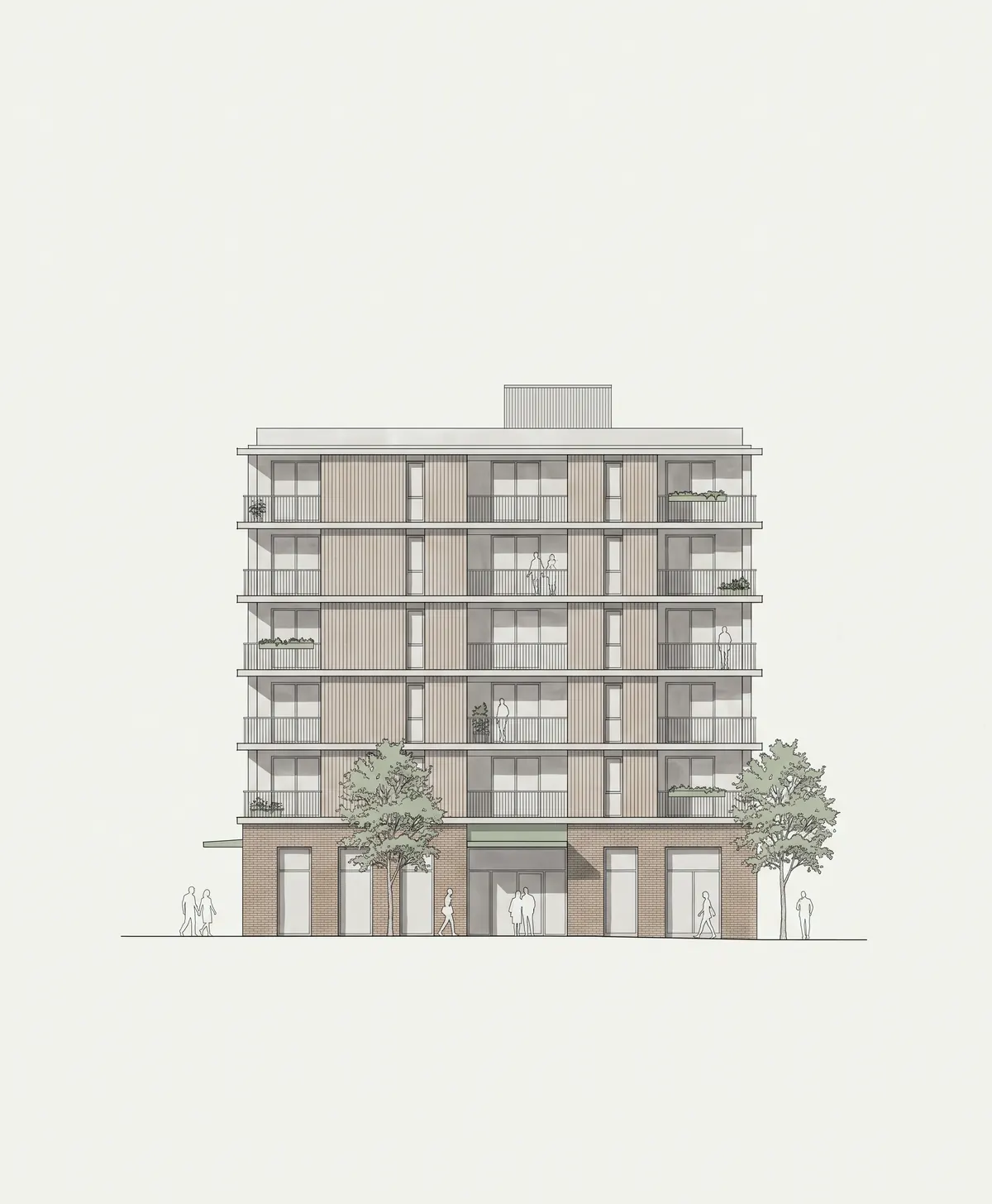
This building dies in underwriting, not in design review.
Nothing about it is wrong. It simply yields in a world. Three numbers, one verdict.
Every move that follows is something you already know how to draw. Watch what each one does to these numbers. Stack them, and the bank says yes.
Stack the moves until the bank says yes.

Tap Add to put a move in the stack, and watch the band.
Not design, but the deals that pay for design. Both take longer to approve, and the model charges for the wait.
The capital stack
Tax credit equity pushes the loan down; more units push the whole stack up.
The paycheck, and the bank's bite
From gross rent to what the investors keep in year one.
Full proforma
Every number the dashboard is built from.
Development budget
Sources of funds
Income
Operating expenses
Debt and year-one returns
Fifteen-year hold and IRR
Underwriter's dials
What the room cannot control, but should feel. Everything else is under Inputs.
About the numbers. This is a teaching proforma, not a pricing model. Costs, rents and rates are plausible 2026 figures for a mid-rise multifamily building in a mid-sized U.S. market and are meant to be argued with; change any of them under Inputs. Credit percentages and eligibility follow the Inflation Reduction Act as amended and the federal and state historic and housing credit programs in general terms. Confirm current law, placed-in-service deadlines and program rules with tax counsel before underwriting a real deal.
Simplifications worth knowing: every deal starts at the loan-to-cost cap with the remainder as equity; credit proceeds first displace the loan, and once the bank's coverage and loan-to-value tests pass the loan is sized to the cushion and further credits displace equity instead; a bridge loan on credit equity is charged during construction and fed back into cost and basis; the federal historic credit is actually claimed over five years and housing credits over ten, which is why they are priced below face; the model does not reduce historic basis for the energy credit or coordinate the two; the fifteen-year IRR treats equity as invested at the start, with operations beginning after construction and any approval delay.
The words the bank uses.
Every term on the dashboard, in plain language, with the deal's live number where there is one.
Make it your building.
Every assumption behind the model. Change a number and the primer, the dashboard and the math panels all update. Your changes stay in this browser.